- Free Photo Recovery Software Mac
- Free Digital Photo Recovery Software For Mac
- Minitool Photo Recovery Free Mac
- Photo Recovery Software Mac
Stellar Photo Recovery for Mac. MiniTool and Stellar Cooperate to Help Mac Users. Recover deleted/lost photos, videos, and music files. Recover RAW formats of popular digital cameras. Recover from SD card, USB, HDD, SSD, CD/DVD, etc. Recover from formatted, encrypted, corrupt drives & media. Restore files with original date, time stamp and name. Repair corrupt photos & videos of various file formats. Mac Photo Recovery for Various Data Loss Scenarios. Stellar Photo Recovery for Mac is a DIY software that recovers photos, videos and audio files lost due to deletion, formatting, or other reasons. Recovers photos from Time Machine, camera memory cards, and other Mac-based storage devices, etc. Recovers photos & videos from lost volumes.
7.1
July 7, 2019
PhotoRec is file data recovery software designed to recover lost files including video, documents and archives from hard disks, CD-ROMs, and lost pictures (thus the Photo Recovery name) from digital camera memory. PhotoRec ignores the file system and goes after the underlying data, so it will still work even if your media's file system has been severely damaged or reformatted.
PhotoRec is free - this open source multi-platform application is distributed under GNU General Public License (GPLV v2+). PhotoRec is a companion program to TestDisk, an application for recovering lost partitions on a wide variety of file systems and making non-bootable disks bootable again.You can download them from this link.
For more safety, PhotoRec uses read-only access to handle the drive or memory card you are about to recover lost data from.Important: As soon as a picture or file is accidentally deleted, or you discover any missing, do NOT save any more pictures or files to that memory device or hard disk drive; otherwise you may overwrite your lost data. This means that while using PhotoRec, you must not choose to write the recovered files to the same partition they were stored on.
Operating systems
PhotoRec runs under
- DOS/Windows 9x
- Windows 10/8.1/8/7/Vista/XP, Windows Server 2016/2012/2008/2003
- Linux
- FreeBSD, NetBSD, OpenBSD
- Sun Solaris
- Mac OS X
and can be compiled on almost every Unix system.
File systems
PhotoRec ignores the file system; this way it works even if the file system is severely damaged.
It can recover lost files from at least
- FAT
- NTFS
- exFAT
- ext2/ext3/ext4 filesystem
- HFS+
ReiserFS includes some special optimizations centered around tails, a name for files and end portions of files that are smaller than a filesystem block. In order to increase performance, ReiserFS is able to store files inside the b*tree leaf nodes themselves, rather than storing the data somewhere else on the disk and pointing to it. Unfortunately, PhotoRec isn't able to deal with this - that's why it doesn't work well with ReiserFS.
Media

PhotoRec works with hard disks, CD-ROMs, memory cards (CompactFlash, Memory Stick, Secure Digital/SD, SmartMedia, Microdrive, MMC, etc.), USB memory drives, DD raw image, EnCase E01 image, etc.
PhotoRec has been successfully tested with various portable media players including iPod and the following Digital Cameras:
- Canon EOS 10D, 60D, 80D, 300D
- Casio Exilim EX-Z 750
- Fujifilm X-T10
- HP PhotoSmart 620, 850, 935
- Nikon CoolPix 775, 950, 5700
- Olympus C350N, C860L, Mju 400 Digital, Stylus 300
- Sony Alpha DSLR, DSC-P9, NEX-6
- Pentax K20D
- Praktica DCZ-3.4
Known file formats
PhotoRec searches for known file headers. If there is no data fragmentation, which is often the case, it can recover the whole file.PhotoRec recognizes and recovers numerous file formats including ZIP, Office, PDF, HTML, JPEG and various graphics file formats.The whole list of file formats recovered by PhotoRec contains more than 480 file extensions (about 300 file families).
Want to know if PhotoRec can recover your files ? Upload a sample file via the PhotoRec online checker (BETA).
How PhotoRec works
FAT, NTFS, ext2/ext3/ext4 file systems store files in data blocks (also called clusters under Windows). The cluster or block size remains at a constant number of sectors after being initialized during the formatting of the file system. In general, most operating systems try to store the data in a contiguous way so as to minimize data fragmentation. The seek time of mechanical drives is significant for writing and reading data to/from a hard disk, so that's why it's important to keep the fragmentation to a minimum level.
When a file is deleted, the meta-information about this file (file name, date/time, size, location of the first data block/cluster, etc.) is lost; for example, in an ext3/ext4 file system, the names of deleted files are still present, but the location of the first data block is removed. This means the data is still present on the file system, but only until some or all of it is overwritten by new file data.
To recover these lost files, PhotoRec first tries to find the data block (or cluster) size. If the file system is not corrupted, this value can be read from the superblock (ext2/ext3/ext4) or volume boot record (FAT, NTFS). Otherwise, PhotoRec reads the media, sector by sector, searching for the first ten files, from which it calculates the block/cluster size from their locations. Once this block size is known, PhotoRec reads the media block by block (or cluster by cluster). Each block is checked against a signature database which comes with the program and has grown in the type of files it can recover ever since PhotoRec's first version came out.
For example, PhotoRec identifies a JPEG file when a block begins with:
- 0xff, 0xd8, 0xff, 0xe0
- 0xff, 0xd8, 0xff, 0xe1
- or 0xff, 0xd8, 0xff, 0xfe
If PhotoRec has already started to recover a file, it stops its recovery, checks the consistency of the file when possible and starts to save the new file (which it determined from the signature it found).
If the data is not fragmented, the recovered file should be either identical to or larger than the original file in size. In some cases, PhotoRec can learn the original file size from the file header, so the recovered file is truncated to the correct size. If, however, the recovered file ends up being smaller than its header specifies, it is discarded. Some files, such as *.MP3 types, are data streams. In this case, PhotoRec parses the recovered data, then stops the recovery when the stream ends.
When a file is recovered successfully, PhotoRec checks the previous data blocks to see if a file signature was found but the file wasn't able to be successfully recovered (that is, the file was too small), and it tries again. This way, some fragmented files can be successfully recovered.
Other topics
- testdisk.pdf More than 60 pages about data recovery using TestDisk & PhotoRec and other tools
- After Using PhotoRec: Some ideas to sort recovered files
- Scripted run: Running PhotoRec without user interaction (Batch mode).
- Developers How to contribute code to TestDisk & PhotoRec
Problems?
Don't hesitate to visit the PhotoRec forum if you have
- some difficulties using PhotoRec,
- some ideas to improve it
If there is a file format you would like to be added, feel free to contact the developer Christophe GRENIER.
When processing photos on mac, we may delete some precious pictures carelessly. Or there are some photos just missing even corrupted after mac update. There are more and more Mac users encountering this dilemma. Don’t worry, here you will find a list of 6 best photo recovery software for mac, no matter you want to do the photo recovery from mac internal hard drive, SD card or external hard disk.
Quick Review of 6 Best Mac Photo Recovery Software
| Pros | Cons | |
|---|---|---|
| Cisdem Data Recovery | Perform Equally Good on Mac, SD Card, hard drive | Not allowed to scan files in specific type |
| Stellar Photo Recovery | Retain original file name | Relatively slow scanning |
| Minitool Mac Data Recovery | Best for partition photo recovery; | Relatively lower recovery rate |
| DiskWarrior 5 | Best for damaged/corrupted photo recovery | High price |
| Remo Photo Recovery | Best for SD Card photo recovery | Not allowed to preview, relatively lower recovery rate |
| PhotoRec | Free | Feature-limited |
2 Features to Make A Photo Recovery Tool Great
As you may have noticed that there are so many photo recovery programs for mac to find back the lost photos. But how can we define a good one? According to the user reviews and related discussions on various platforms, there are 3 important features that a good photo recovery tool should build in:
- Fast Scanning Speed.
Your photo library can never be small in quantity, right? To scan and find out the missing or lost photos on mac, the photo recovery software should respond fast and scan in a fast speed, especially when you are not sure the location where you store the lost photos on a 500GB Mac, or 16GB sd card, or 2TB external hard drive. - Recovered Photos can be opened.
Finding back the photos is not the end of a mac photo recovery job, a successful photo recovery means the recovered photos should be opened and worked on normally. And any good mac photo recovery software should be capable of doing so.
6 Best Photo Recovery Software for Mac
In the beginning, I planned to list 15~20 recovery tools in this post, but as I took more and more tests, I realized that some from the previously long list are just not qualified to be the best ones. Also for the reason I want to direct all my efforts to those ones that really worth a try, I finally shortened my list of best photo recovery software for mac to be 6 options as following.
#1 Cisdem Photo Recovery for Mac---The Best
The first and also the best mac photo recovery tool is Cisdem Data Recovery. The program came into service since in 2013, it has been under active developments and updates for these years. Due to its high recovery rate and user-friendly interface, more and more users pick or recommend it as the 1st choice to recover photo files on mac.
It supports photo recovery from SD card on all kinds of camera or media players and help to recover various type of photo format, be it popular, or raw image, or others.
Why Cisdem Photo Recovery?
- Recover missing, deleted, lost, formatted or other photos caused by different reasons
- Recover virtually all types of photos (mainstream, raw image and others)
- Recover 200+ types of files (photo, video, audio, document, archives, etc.)
- Recover files from internal/external hard drives, SD card, USB drive, etc and perform equally outstanding
- Preview files before recovery
- High recovery rate
- Files can be opened after recovery
- Easy to use
Where Cisdem Photo Recovery Excel?
In terms of scanning speed and simplicity to use, Cisdem is equally matched with other 5 tools, but where Cisdem excels is lies in its stable performance to recover photos successfully. It can not only find out as many as photos, even those hidden deep on your mac that you are not even aware of their existence, but also recover up to 95% of your lost photos. And for these recovered photos, up to 98% of them can be opened normally, except those ones have been damaged or corrupted in the first place.
In addition, it supports virtually all kinds of photo formats, including mainstreams ones such as JPG, PNG, BMP, GIF, TIFF, or raw images for different cameras and others, total 48 formats.
How to Use Cisdem Photo Recovery?
Step 1Download and install the free trial of Cisdem Photo Recovery on mac.
Step 2Choose a recovery mode.
Cisdem offers 5 recovery modes for users to recover photos lost due to different situations. You can start with the basic recovery mode and try the advanced recovery mode if the recovery results don’t meet your needs.

Step 3Select to do photo recovery on SD Card or hard drive.
Cisdem Photo Recovery will show all the storage devices on your mac, select the location where your photos get lost and click “Scan” to find out the lost photos.
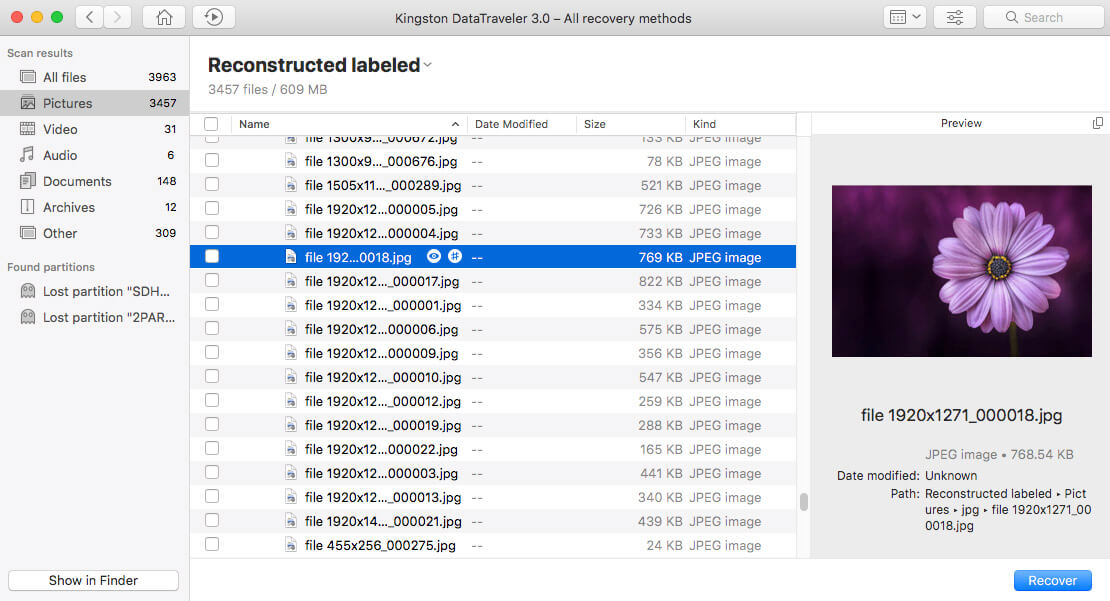
Step 4Preview photos before recovery.
Once the scanning finishes, go to the Photo folder and find your photos, preview the files.
Step 5Recover photos on mac.
Select all the photos you want to recover, then click “Recover” to restore.
#2 Stellar Photo Recovery
If you have been looking for data recovery tool for some time, you should have heard about Stellar Phoenix data recovery, it is always one of the most powerful tool to deal with data loss. For mac photo recovery, we highly recommend the Stellar Photo Recovery rather than Stellar Mac Data Recovery, which has been complained of taking too much time for scanning by users. The Stellar Photo Recovery can only recover photos, videos and audios.
Where Stellar Photo Recovery Excel?
When working on photo recovery, the issue “found files are named weirdly” is always a headache, so we need to preview each photo one by one to make sure we are recovering the wanted photos. Luckily, Stellar Photo Recovery does a good job on this issue, though there are some found photos are still named with strange series numbers, it does helps us to fast find and select the wanted photos for recovery.
How to Use Stellar Photo Recovery?
- Download and install Stellar Photo Recovery on your mac;
- Choose to scan everything or scan photos only;
- Select the location to do photo recovery;
- Preview the files before photo recovery;
- Then click “Recover” to get the lost photos back onto your mac.
#3 MiniTool Mac Data Recovery for Mac
MiniTool is based in Canada and dedicated to provide customers with solutions in the filed of data process, such as data recovery and backup. It offers both personal and commercials editions for different users. For more than a decade, MiniTool has won a lot of users due to its outstanding performance to recover data on mac.
Is MiniTool Free to Use?
When talking about MiniTool Photo Recovery, many users are trying to figure out if MiniTool is really free to use since it claims to be free.
However, in my opinion, it is not free. Yes, it is free to scan the data on your mac, but only 1MB data can be restored. Obviously, 1-mb data restoration won’t never meet our needs, so at last, we will have to pay if you want to recover photos or other files using MiniTool.
Where Mini Tool Mac Data Recovery Excel?
As you may have learnt from it main interface, MiniTool makes much efforts to recover data from damaged or lost partition, in light of that many users prefer to partition their mac hard drive into separate parts for different uses. So, if you are one among these users, MiniTool is a good choice for you to recover photos and other files from partitions on your mac. Still, you can try its digital media recovery to recover photos on mac from a SD card or other memory cards.
How to Use MiniTool Photo Recovery?
- Download and install MiniTool Photo recover on your mac;
- Choose a recovery mode, for example, the Digital Media Recovery;
- Choose the target device, then click “Full Scan”;
- After the scanning, all found photos will be listed, preview;
- Select the photos you want to recover, then click ‘Save” and choose the output partition to recover.
#4 DiskWarrior
DiskWarrior 5 from Alsoft is absolutely a super powerful data recovery tool to even recover damaged, corrupted and inaccessible files on mac. Alsoft itself is a company developed by 2 former Apple employees in 1984, while its product, DiskWarrior 5 is a award-winning repair and data recovery tool that recommended by tech authorities for years. Due to its prominence, DiskWarrior 5 comes with a high price tag.
Where DiskWarrior Photo Recovery Excel?
Very often, we find some of our photos cannot be opened, they are just damaged or corrupted , even we cannot access to these photos since we can not open and view files on the hard drive properly. In this case, you will need a tool to repair your hard disk or storage device first, then get the photos back, and this is what DiskWarrior can do for users. Still, you can use this tool to detect and monitor errors on your mac, saving your troubles of lost of damaged data caused by the hard drive problems.
How to Use DiskWarrior Photo Recovery?
- Download and install DiskWarrior 5 on your mac;
- Choose the hard disk to repair, then click “Rebuild”;
- Then go back to check if the photos can be accessed or opened.
#5 Remo Photo Recovery
Remo Software is an India-based company focusing on data recovery, repair, backup and management. Undoubtedly, it is a trusted data recovery software developer basing on its 6-year professional services. Though you can find Mac Data Recovery and Photo Recovery on its website, they are the same program, you just need to try the Remo Mac Data Recovery since it builds in a photo recovery software.
Where Remo Photo Recovery Excel?
To tell you the truth, Remo Photo Recovery is the one took me the most time and efforts to finish a photo recovery process. You need to choose between different options, which seemingly unnecessary to me. But it does a relatively better job on recovering photos from SD card, also you are allowed to scan and recover photos only using Remo.
How to Use Remo Photo Recovery?
- Download and install Remo Photo Recovery on mac;
- Choose “Recover Photos”> “Recover deleted photos” or “Recover lost photos”;
- Select the location for scanning and click “Next”;
- Mark the types of files your want to select, for example, the “Picture”. Then click “Next”;
#6 PhotoRec---Best Free
Free Photo Recovery Software Mac
PhotoRec is a 100% free and clean data recovery software to recover videos, documents, archives and photos. And this is also the reason why PhotoRec is picked as the best free photo recovery software for mac. It is available on different platforms, including macOS, Windows, Linux, etc. Since the program is command-line based, you need to run with Terminal to do the photo recovery.
Free Digital Photo Recovery Software For Mac
Where PhotoRec Excel?
In fact, when comparing with other mac photo recovery software in my list, PhotoRec has no way to outperform others in performance, versatility and user experience. However, as far as I know, it is the only 1 100% free and safe program to recover photos on mac. So if you have photos in a small quantity that need to be recovered, it is worth a try.
How to Use PhotoRec?
- Download and install PhotoRec on your mac;
- Run PhotoRec with Terminal;
- Use the arrow key choose the location for scanning;
- Once ready, press the C key to start scanning;
- Then the photos will be recovered and check the destination folder;
How to Avoid Photo Loss?
To never ever use a mac photo recovery software, we should be aware of following tips to avoid photo loss:
- Always back up photos on iCloud or external hard drive;
- Handle your SD Card or any other storage devices with care: do not force eject the SD Card, do not bend or keep your SD Card or others in environment that is either too hot or too cold, do not water them……;
- Install anti-virus programs to protect your photos on mac;
- Name each photo folder, so you won't accidently delete;
- Back up files before any mac update;
Minitool Photo Recovery Free Mac
Final Words
Photo Recovery Software Mac
You may find many other options that can be picked as the best photo recovery software for mac, but according to our practices, the 6 photo recovery software on our list are proved to be outstanding and worth a try.